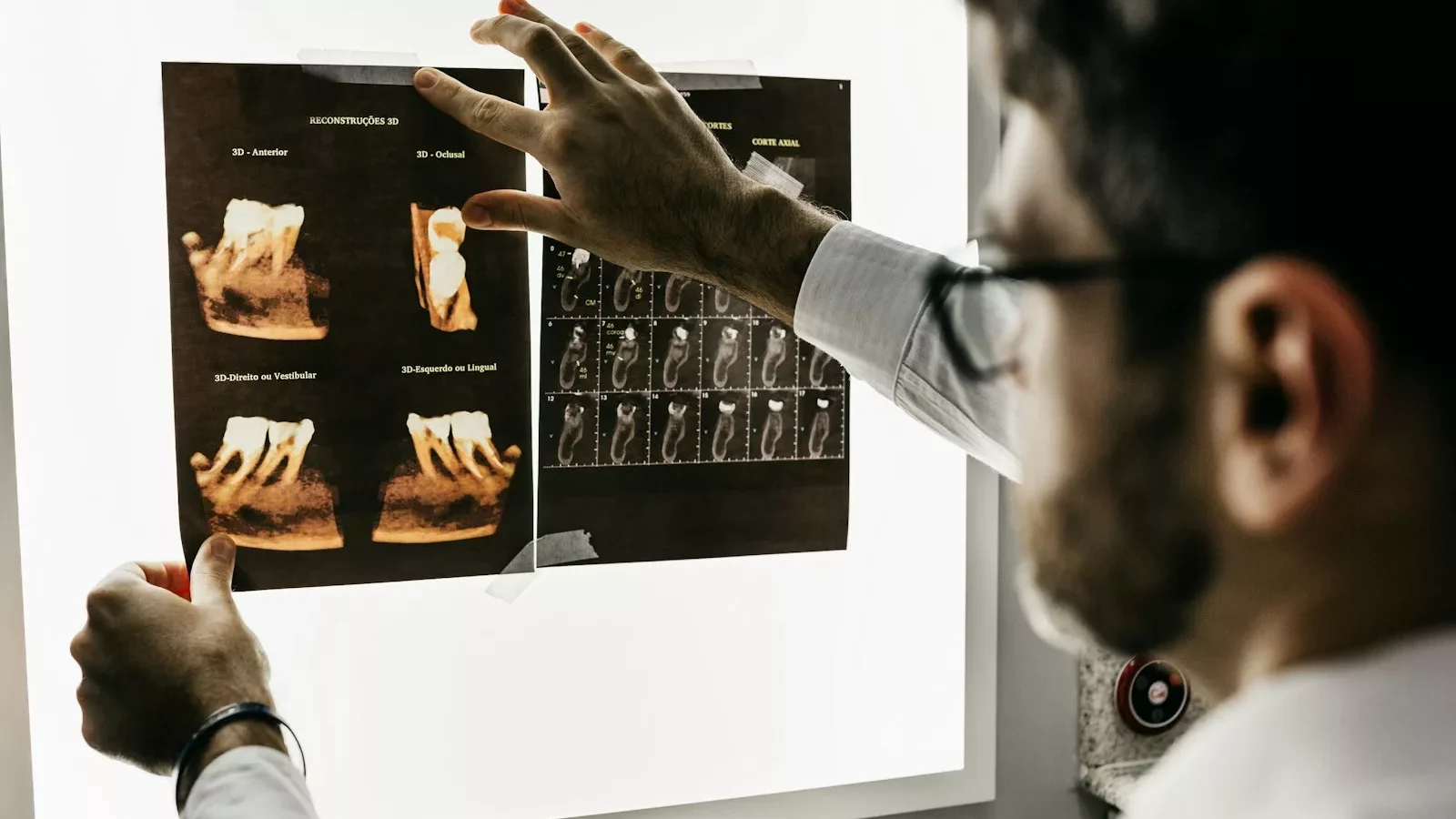
Prosthetic dentistry is about rebuilding what has been lost: a tooth too damaged to be restored with a filling, one or more missing teeth, an entire arch. The aim is not simply to fill a gap but to restore effective chewing and a balanced bite, in which load is distributed as it should be.
At the practice of Dr. Naim René Asmar in Aosta, open since 1992, every prosthetic rehabilitation starts from an assessment of the remaining teeth and supporting tissue: the best solution in the abstract is not necessarily the one that is feasible in a particular mouth.
Fixed prosthetics
Crown
A covering that encases a badly damaged or root-treated tooth, restoring its shape and strength. It is indicated when the remaining structure is not sufficient to support a filling: after root canal treatment in particular, back teeth become more brittle and a crown protects them from fracture.
Bridge
Replaces one or more missing teeth by resting on the neighbouring teeth, which are prepared to receive the supporting crowns. It is a well-established solution, but it involves reshaping teeth that may be healthy: for that reason, where conditions allow, the possibility of an implant is considered first.
Inlay
A restoration made in the laboratory and then cemented into the cavity. It sits between a filling and a crown: it is used when tissue loss is too extensive for a direct composite but the tooth is still sound enough not to require full coverage. It allows more healthy tissue to be preserved.
Removable prosthetics
Partial denture
Replaces some teeth, resting on the remaining ones by means of clasps or precision attachments. It is indicated when the missing teeth are numerous or distributed in a way that makes a fixed solution unfeasible.
Complete denture
Replaces an entire arch and rests on the mucosa. Its stability depends on the shape of the remaining bony ridges; where these have resorbed, the denture tends to move. This is the main limitation of the solution, and the reason stabilising it is often considered.
Implant-supported prosthetics
A limited number of implants can anchor a removable prosthesis, which remains detachable for cleaning but does not move during chewing, or support a fixed screw-retained prosthesis. This is the solution that most changes daily life for anyone wearing an unstable complete denture.
Materials
- All-ceramic (lithium disilicate, zirconia): high aesthetic quality and no metal substructure. Today it is the prevalent choice in visible areas.
- Metal-ceramic: a metal framework covered with ceramic, long established and very strong, still indicated in some situations.
- Composite resins: used above all for temporary restorations and transitional work.
The choice depends on the position of the tooth, the chewing forces it must withstand and aesthetic requirements. In posterior sectors strength matters more; at the front, colour rendering does.
How treatment proceeds
Case study
Assessment of the remaining teeth, gums, supporting bone and the way the arches meet. Radiographs and models are used to plan, not merely to record.
Preparation and impression
The teeth involved are prepared and an impression taken, conventional or digital. Meanwhile a temporary restoration is fitted, which protects the tooth and allows appearance and comfort to be checked before the definitive one.
Try-in and fitting
The restoration is tried in and adjusted: contacts, shade and shape are checked. Only when these are correct is it definitively cemented or screwed into place. Any corrections are made at this stage, not afterwards.
Maintenance
A prosthesis does not become diseased, but the teeth and gums supporting it can. Crown margins are the points where plaque accumulates most readily and is hardest to remove; beneath a removable prosthesis, the mucosa must be cleaned daily.
For this reason prosthetic rehabilitation always goes with check-ups and professional hygiene at defined intervals. Anyone who grinds their teeth at night should also be assessed for a night guard: bruxism is the most frequent cause of ceramic fracture.
At Studio Asmar, in Aosta
The practice is at Via Torre del Lebbroso 25, in the centre of Aosta. A prosthetic rehabilitation is built over several appointments and maintained over years: the continuity of a practice open since 1992 makes it possible to follow the restoration over time and to act promptly on what changes.
Appointments are held in Italian, English and French, and the practice is also open on Saturdays and during August. For a prosthetic assessment, get in touch.