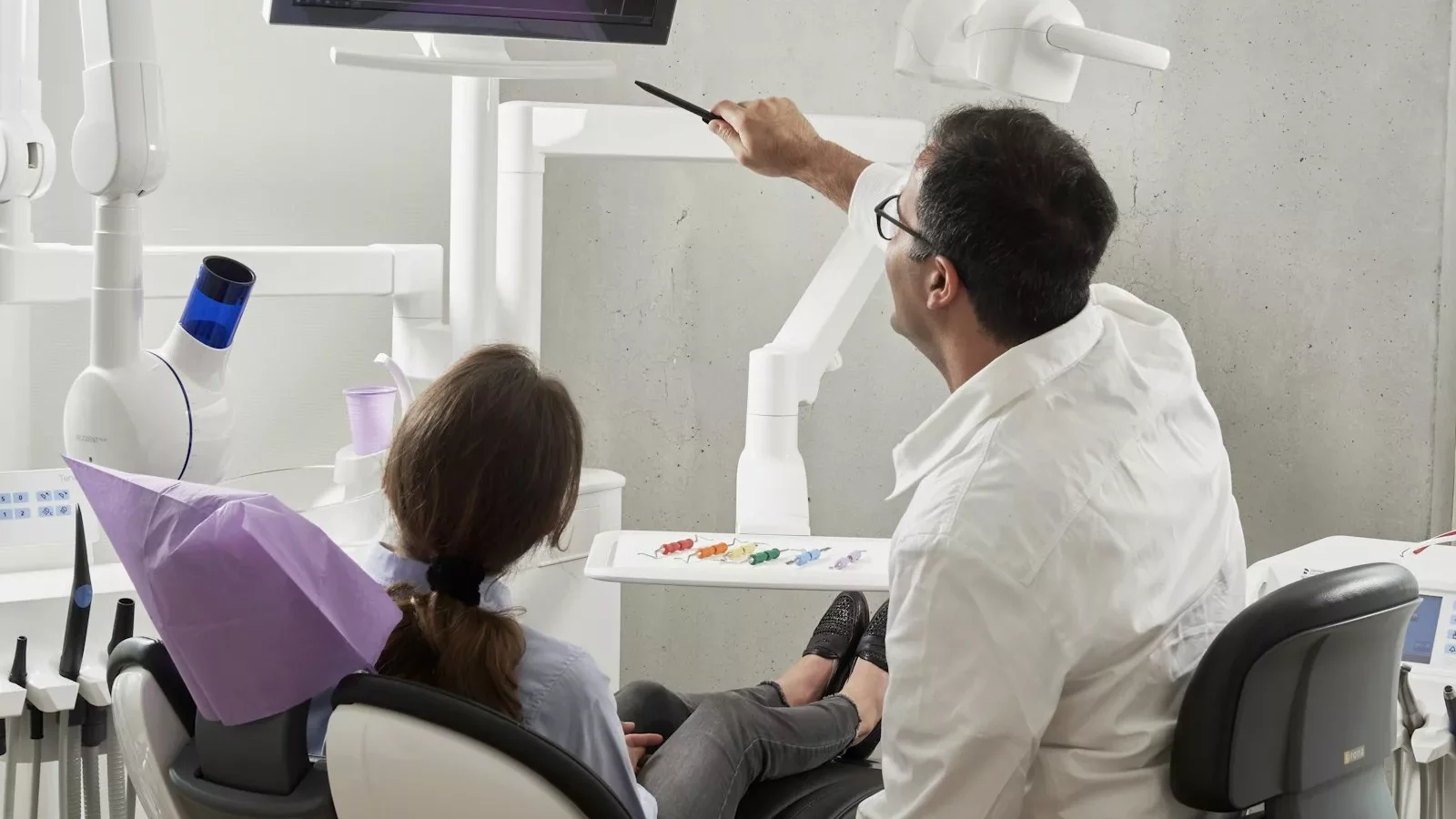
Root canal treatment — clinically, endodontic treatment — is the procedure that saves a tooth whose pulp, the living tissue inside it, is irreversibly inflamed or infected. The diseased tissue is removed, the root canals are cleaned and shaped, and then sealed.
One widespread misconception is worth clearing up: root canal treatment is not what causes the pain, it is what resolves it. The pain that brings people in is the pain of ongoing inflammation; the treatment removes its source. At the practice of Dr. Naim René Asmar in Aosta the aim is always the same: to keep the natural tooth where it is reasonable to do so, rather than extract it and have to replace it.
When it is needed
- Deep decay that has reached the pulp.
- Irreversible pulpitis: spontaneous pain, often at night, persisting long after a hot or cold stimulus.
- Pulp necrosis, which may progress without symptoms and be revealed only by a radiograph.
- An abscess or swelling linked to infection that has spread from the root into the surrounding bone.
- Trauma that has compromised the vitality of the tooth, even months or years later.
- Retreatment of a previous procedure that has not healed.
The signs to recognise
The typical picture is pain that does not go away: spontaneous, throbbing, worse when lying down and barely relieved by painkillers. At other times the tooth reacts in a prolonged way to heat and is briefly soothed by cold — a reversal of ordinary sensitivity, and a fairly specific sign.
There is not always pain, however. A tooth can become necrotic silently, with the lesion at the root apex showing up as a dark area on a radiograph taken for other reasons. It is one of the reasons regular check-ups make sense even in the absence of symptoms.
How the treatment works
Diagnosis
Vitality tests, clinical assessment and radiographs. These establish which tooth is actually responsible — dental pain is often poorly localised, and it is not unusual for patients to point to the wrong tooth — and whether root canal treatment is the right course.
Anaesthesia and isolation
The procedure is carried out under local anaesthetic: no pain is felt during the appointment. The tooth is isolated with a rubber dam, a sheet that separates it from the rest of the mouth. This is not an accessory: it prevents saliva and bacteria from contaminating the canals during the work, and it is one of the elements that most affects the long-term outcome.
Cleaning and shaping
The diseased tissue is removed and the canals shaped with fine instruments, irrigated with disinfectant solutions. This is the central stage: most of the work consists of disinfecting rather than removing.
Filling the canals
The canals are filled with a material that seals them stably, preventing bacteria from recolonising them. Depending on the case, treatment is completed in one or two visits.
Restoration
A root-treated tooth is more brittle, because it has lost tissue and is no longer hydrated from within. Restoration is an integral part of the treatment, not an addition: in back teeth a crown is normally used, protecting against vertical fracture — the most frequent cause of losing a root-treated tooth.
After treatment
In the following days the tooth may feel tender when biting: this is a reaction of the tissue around the apex and settles gradually. It is best to avoid chewing on that side until the definitive restoration is complete, because a weakened and as yet unprotected tooth is at its greatest risk of fracture.
A follow-up radiograph checks that any lesion at the apex is healing: this takes months, and verifying it is part of the treatment.
Why keep the tooth
A natural tooth, even root-treated, keeps its own periodontal ligament: it senses pressure, transmits physiological stimuli to the bone and maintains the space in the arch. Replacing it is possible — with an implant or a bridge — but it involves a longer course and, in the case of a bridge, the involvement of the neighbouring teeth. Where root canal treatment is feasible with a good prognosis, keeping the tooth remains the preferable choice.
At Studio Asmar, in Aosta
The practice is at Via Torre del Lebbroso 25, in the centre of Aosta, open since 1992. Appointments are held in Italian, English and French, and the practice is also open on Saturdays and during August: which matters when pain does not wait for Monday.
If you have persistent pain or swelling, get in touch without delay.