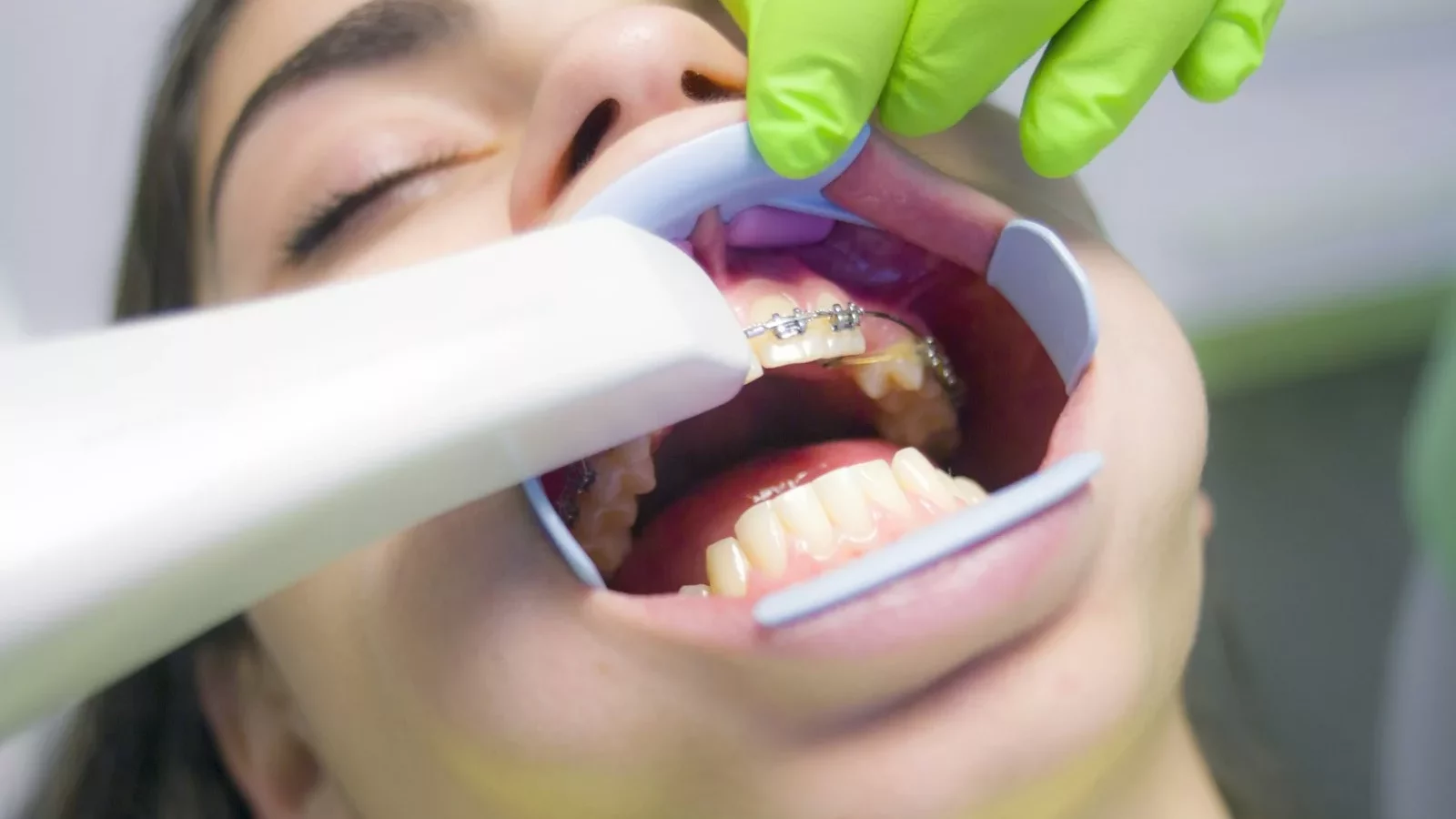
Orthodontics deals with the position of the teeth and the relationship between the two arches. It is not only a matter of how a smile looks: poorly positioned teeth are harder to clean and therefore more exposed to decay and gum inflammation, and an unbalanced bite can load the jaw joint and some teeth more than others.
At the practice of Dr. Naim René Asmar in Aosta, orthodontic treatment always begins with a full assessment of the mouth, because the choice of appliance depends on the type of problem, on age and on the daily habits of the person who will wear it.
What orthodontics corrects
- Crowding: the teeth do not find room on the arch and overlap.
- Diastemas: excessive gaps between teeth.
- Deep or open bite: the upper incisors cover the lower ones too much, or fail to meet them at all.
- Crossbite: the transverse relationship between the arches is reversed, in one or more sectors.
- Impacted teeth: teeth that have not erupted and need to be guided into the arch.
- Relapse: teeth that have moved out of line again years after previous treatment.
The available solutions
Fixed appliances
Brackets bonded to the tooth surface and connected by a wire that transmits the force. This is the most versatile option: it allows movements the others do not, and it does not depend on patient cooperation because it cannot be removed. Brackets can be metal or tooth-coloured ceramic, which is less visible.
Removable and functional appliances
Removable devices used above all during growth, when it is possible to guide the development of the jawbones rather than simply move the teeth. Intercepting a crossbite or a discrepancy between the arches at this stage can considerably simplify later work.
Clear aligners
Removable, barely visible trays, suitable for mild to moderate crowding, diastemas and relapse. This is the option adults most often choose: its indications, timescales and rules of use are described on the page about invisible orthodontics.
The right age for a first assessment
For children, a first assessment around the age of six or seven is useful even in the absence of obvious problems: at that stage baby and permanent teeth coexist, and it is the moment when situations worth intercepting early become recognisable. It does not mean starting treatment straight away — often the conclusion is simply to review in a year’s time.
For adults there is no upper age limit. What matters is not the date of birth but the health of the gums and supporting bone: on a healthy periodontium, teeth move at any age.
How treatment proceeds
Examination and records
Clinical assessment, radiographs, photographs and impressions or a digital scan of the arches. These establish the starting point and make it comparable with the result to be achieved.
Treatment plan
Goals, appliance, estimated duration and number of review appointments are defined. This is also the moment to discuss alternatives: almost always more than one route is viable, with different advantages and limits.
Preliminary care
Any decay and gum inflammation are treated before the appliance is fitted. An initial professional cleaning is standard: during orthodontic treatment home care is more demanding, and it is best to start from a healthy mouth. The page on hygiene and prevention explains how the appointment works.
Reviews and retention
Regular appointments serve to adjust the appliance and check progress. Once treatment is complete, retention keeps the result stable: a wire bonded behind the teeth, a night-time retainer, or both.
Oral hygiene during treatment
With a fixed appliance, plaque finds more places to settle. Toothbrush, interdental brushes and — where indicated — a water flosser become daily tools, and professional cleaning appointments are scheduled more closely than usual. This is the aspect that most affects dental health at the end of treatment, and it is worth being methodical about.
At Studio Asmar, in Aosta
The practice is at Via Torre del Lebbroso 25, in the centre of Aosta, where Dr. Asmar has worked since 1992. Orthodontic treatment lasts months and is measured in regular appointments: the continuity of the practice over time is part of what makes it manageable.
Appointments are held in Italian, English and French, and the practice is also open on Saturdays and during August — useful for families, who can often only arrange reviews outside school hours.
For an orthodontic assessment, get in touch and we will arrange an appointment.