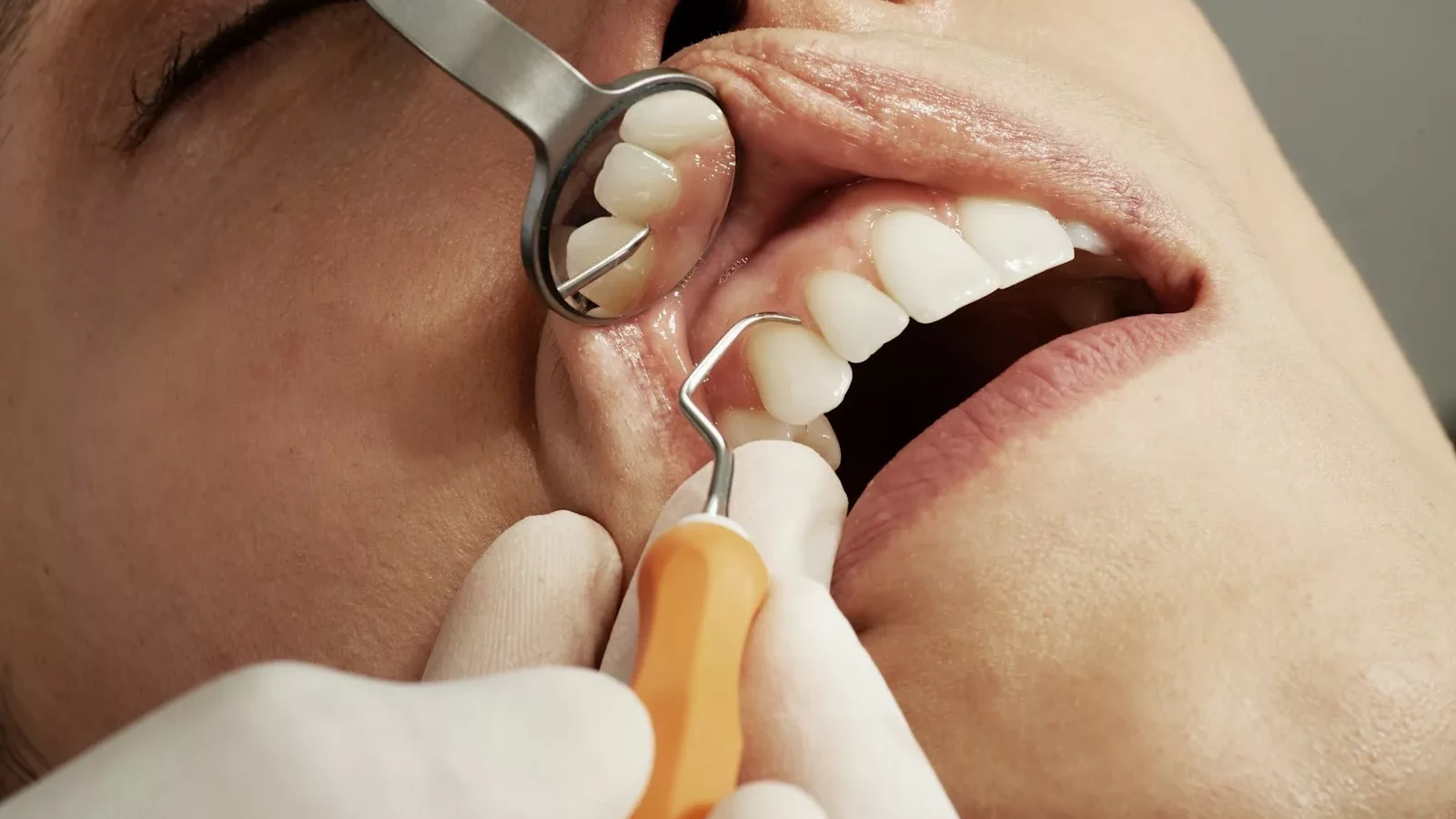
Teeth whitening lightens the natural shade of the teeth by acting on the pigments held within the enamel and dentine. It is not a more vigorous cleaning: removing surface stains from coffee, tea, wine or tobacco belongs to the professional hygiene appointment, and returns the tooth to the colour it already has. Whitening changes the underlying shade.
At the practice of Dr. Naim René Asmar in Aosta, the treatment is always preceded by an examination. This is not a formality: it determines both the result that can realistically be expected and whether there are situations in which whitening is unsuitable.
How it works
The active ingredient is a gel based on hydrogen or carbamide peroxide. Applied to the tooth surface, it releases oxygen that penetrates the tissue and breaks down the pigmented molecules responsible for the colour. Enamel is neither removed nor thinned: what changes is the way it reflects light, not its thickness.
The concentration of the gel and the contact time distinguish the two main approaches.
In-practice whitening
Higher concentrations, applied by the dentist after protecting the gums and soft tissue with a barrier. The appointment generally lasts between sixty and ninety minutes and the change is visible immediately. It suits those with a fixed deadline or who prefer to concentrate treatment into a single visit.
Home whitening
Clear trays made to measure from an impression of the arches, filled with a lower-concentration gel and worn for a set time, usually over one or two weeks. The action is more gradual and, for that reason, often involves less sensitivity. The trays remain usable afterwards for occasional touch-ups.
The two approaches are frequently combined: an in-practice session followed by home maintenance.
When it is suitable, and when it is not
Whitening gives its best results on the diffuse discolouration linked to age and diet, that is on the gradual loss of brightness affecting all the teeth uniformly.
There are situations in which it should be postponed or replaced by another approach:
- Decay or defective restorations: the gel would reach exposed dentine. These must be treated first.
- Inflamed gums or marked recession: they increase the risk of sensitivity and should be stabilised first.
- Crowns, veneers and composite fillings: artificial materials do not lighten. If they are in a visible area, after whitening they will appear darker than the natural teeth and will need replacing. This is the point most often underestimated, and it must be planned before starting.
- Tetracycline staining or a root-treated tooth: these respond differently and require specific techniques, such as internal whitening of a single tooth.
- Pregnancy and breastfeeding: as a precaution, treatment is postponed.
- Under the age of eighteen, when the pulp chamber is still large.
Sensitivity
This is the most common side effect: brief twinges with hot and cold, appearing during or shortly after treatment. It is temporary and generally resolves within a few days. It can be limited by reducing contact times, spacing applications or using desensitising toothpaste beforehand. Anyone with pre-existing sensitivity is assessed with particular care.
How long the result lasts
There is no guaranteed duration: it depends largely on habits. Coffee, tea, red wine, pigmented spices and above all smoking gradually return the colour towards its starting point. In ordinary circumstances the result remains noticeable for a period of some months to a few years, and can be refreshed with maintenance applications.
In the days immediately afterwards the enamel is temporarily more receptive to pigments: limiting the most staining drinks in the first forty-eight hours is the precaution that matters most.
Over-the-counter kits and non-professional treatments
Freely available kits and treatments carried out outside a dental practice have two concrete limitations: they act on a mouth nobody has examined, and they use trays not shaped to the arches, which leave the gel in contact with the gums. The risk is not a disappointing result but gum irritation and prolonged sensitivity. The preliminary assessment is the step not worth skipping.
At Studio Asmar, in Aosta
The practice is at Via Torre del Lebbroso 25, in the centre of Aosta, open since 1992. Appointments are held in Italian, English and French, and the practice is also open on Saturdays and during August.
To find out whether whitening is suitable in your case and which approach is preferable, get in touch for an assessment.